Light, Dark, and Everything In Between: How Scandinavia Stays Sane Through the Seasons
In Tromsø, Norway, the sun doesn't rise at all between late November and mid-January. For nearly two months, residents go about their days — school runs, coffee dates, grocery trips — in complete polar darkness. In June, the same city won't see darkness for months. The sun simply circles the sky without ever dipping below the horizon.
For most Americans, this sounds like a wellness nightmare. But here's the curious thing: Norway, Denmark, Sweden, and Finland consistently rank among the happiest countries on earth. Iceland, with its own dramatic light extremes, isn't far behind. So either the happiness rankings are lying, or these cultures have figured out something genuinely useful about living in relationship with light — something the rest of us might want to pay attention to.
The Science of Seasonal Light and Your Brain
Before we get into what Scandinavians actually do, it helps to understand what extreme light variation does to the human body. Light is the primary regulator of circadian rhythm — the internal clock that controls sleep, hormone production, mood, and appetite. When daylight patterns shift dramatically, as they do at high latitudes, the body has to work hard to recalibrate.
Seasonal Affective Disorder (SAD) is the clinical term for the depression that affects an estimated 10 million Americans each year, predominantly in northern states. Another 10 to 20 percent experience a milder version sometimes called the "winter blues." SAD is directly linked to reduced light exposure, which suppresses serotonin production and disrupts melatonin regulation.
Nordic countries are not immune to this. Studies have found elevated rates of winter depression in Scandinavia, particularly in areas with the most extreme darkness. But the key difference is how those societies respond — both medically and culturally.
Light Therapy: A Nordic Export That Actually Works
Light therapy boxes — devices that emit bright, full-spectrum light mimicking outdoor daylight — have been standard tools in Nordic mental health care for decades. In the US, they've gained traction more recently, though many Americans are still unfamiliar with them.
The research is pretty solid. A 2015 study published in JAMA Psychiatry found that light therapy was as effective as antidepressants for treating seasonal depression — and worked faster. The standard protocol involves sitting near a 10,000-lux light box for 20 to 30 minutes each morning, ideally within an hour of waking.
In countries like Sweden and Norway, these devices are widely used and often covered by healthcare systems. In Finland, public health recommendations actively encourage light therapy use during the dark months. It's not a fringe wellness product — it's mainstream medicine.
If you live in Seattle, Minneapolis, Chicago, or anywhere north of roughly the 40th parallel, a light therapy box is probably worth considering. They run anywhere from $50 to $150 and are available through major retailers.
The Cultural Attitude Shift: Darkness as a Feature, Not a Bug
Here's where it gets philosophically interesting. Nordic cultures have, over centuries, developed a fundamentally different emotional relationship with darkness than most Americans have.
In the US, darkness is generally framed as something to overcome — we light up our cities aggressively, stay productive around the clock, and treat the desire to slow down in winter as a personal failure. "Seasonal depression" is treated as an illness that interrupts normal life. Get better and get back to speed.
In Norway, there's a concept called mørketid — literally "murky time" or "dark time" — that describes the polar night period. But rather than treating it as a crisis, many Norwegians frame it as a season with its own legitimate character. A time for interiority, for slowing down, for indoor warmth and long evenings. The darkness isn't the enemy; fighting the darkness is.
Researchers at the University of Tromsø studied this attitude directly and found that people who reframed winter darkness as cozy, beautiful, or meaningful reported significantly lower rates of seasonal depression than those who viewed it negatively. The same objective conditions, processed through different cultural lenses, produced measurably different mental health outcomes.
That's a remarkable finding — and a deeply practical one.
Folk Traditions That Function as Wellness Practices
Long before anyone had a word for light therapy or circadian rhythm, Nordic communities developed traditions that served many of the same functions.
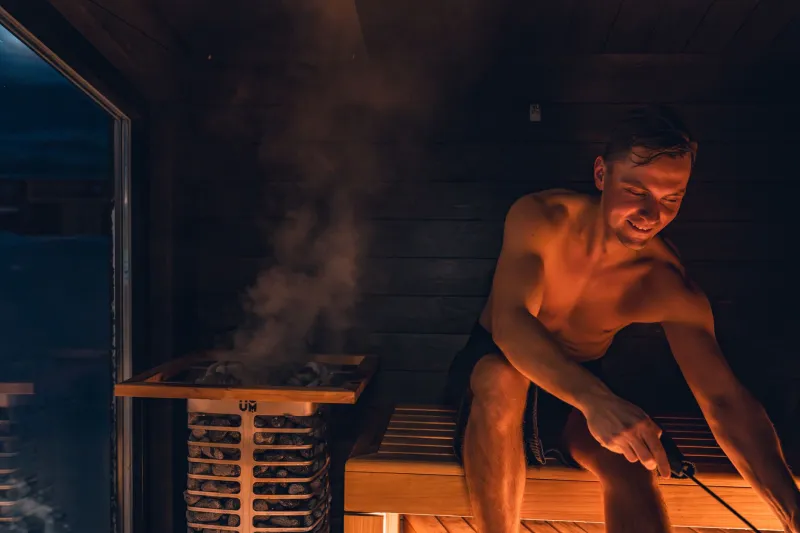
The sauna is probably the most well-known. Finnish sauna culture — recognized by UNESCO as an Intangible Cultural Heritage — is a communal, deeply ritualized practice. The heat promotes circulation and relaxation, but the social dimension matters just as much. Regular sauna use has been associated in Finnish studies with lower rates of depression, cardiovascular disease, and all-cause mortality. Americans have increasingly embraced saunas, though often as a solo wellness activity rather than the communal event it is in Finland.
Friluftsliv (free-air life) is a Norwegian and Swedish concept describing the cultural commitment to outdoor life regardless of weather. "There is no bad weather, only bad clothing" is a phrase Scandinavian parents tell their children — and they mean it. Studies consistently show that outdoor time in natural light, even on overcast winter days, has measurable positive effects on mood and vitamin D levels. The Nordic answer to winter isn't to go inside — it's to dress properly and go outside anyway.
Midwinter celebrations — from the Swedish Lucia festival in December to various pre-Christian traditions involving fire and light — serve a psychological function of marking the darkness as temporary and communal. These aren't just pretty traditions. They're collective acknowledgments that the darkness is shared, that it will pass, and that community is the antidote.
What Americans Can Actually Do With This
You don't need to move to Bergen or install a commercial sauna to apply these principles. Here are some genuinely practical takeaways:
Try a light therapy box. Seriously. If you live north of Chicago and notice your mood tanking in November, this is the most evidence-backed, underutilized tool available.
Go outside in the morning. Even on gray days, outdoor light is substantially brighter than indoor light and will help regulate your circadian rhythm. A 20-minute morning walk beats a perfect workout done at noon under fluorescent lights.
Reconsider your relationship with winter. This one is harder but possibly more important. What if you stopped waiting for spring and started finding what's actually good about the cold months? Slower pace, heavier food, more evenings in — these aren't deprivations. They're a different kind of richness.
Invest in your social infrastructure. Nordic wellness during dark months is fundamentally communal. Regular dinners, consistent social plans, and community events all serve as protective factors against isolation. Don't wait to feel like socializing — build the structure and let the feeling follow.
Vitamin D supplementation. Nordic health authorities widely recommend supplementation during winter months, and most Americans are deficient year-round. Talk to your doctor, but the evidence base here is substantial.
The Nordic relationship with seasonal extremes isn't about toughness or stoic endurance. It's about adaptation — building cultural, physical, and psychological systems that work with the natural world rather than against it. In a country that sometimes treats winter as a problem to be solved, that's a genuinely different way of seeing things.
And given the happiness data coming out of Scandinavia year after year, it might just be a better one.