Let the Kid Fall: Why Scandinavian Parents Trust Their Children More Than American Parents Think Is Legal
Picture this: a stroller parked outside a Copenhagen café on a brisk November afternoon. Baby inside, sleeping. Parents inside, drinking coffee. No one panicking. No one calling anyone.
For most American parents, that image either sounds like a dream or a crime. In Denmark, it's just lunch.
The gap between how Scandinavians and Americans raise children isn't just a matter of style — it reflects two genuinely different theories about what kids are, what they need, and what parents are actually responsible for. And the more you look at the Nordic approach, the harder it becomes to argue with the results.
The Myth of the Hands-Off Parent
First, let's get one thing straight: Scandinavian parents aren't neglectful. They're not checked out, indifferent, or running some kind of social experiment on their kids. Nordic parents are deeply involved in their children's lives — emotionally present, communicative, and intentional about how they raise them.
The difference is where they draw the line between support and control.
In the U.S., helicopter parenting has become so normalized that opting out of it can feel like opting out of good parenting altogether. Scheduling playdates months in advance, monitoring school apps in real time, intervening in playground disagreements before they even fully develop — these behaviors are so common they barely register as unusual anymore. They're just what you do when you care.
Scandinavian parents care just as much. They just express it differently. Rather than removing obstacles from a child's path, the Nordic instinct is to let the child encounter the obstacle and figure out what to do with it.
Friluftsliv Starts Young
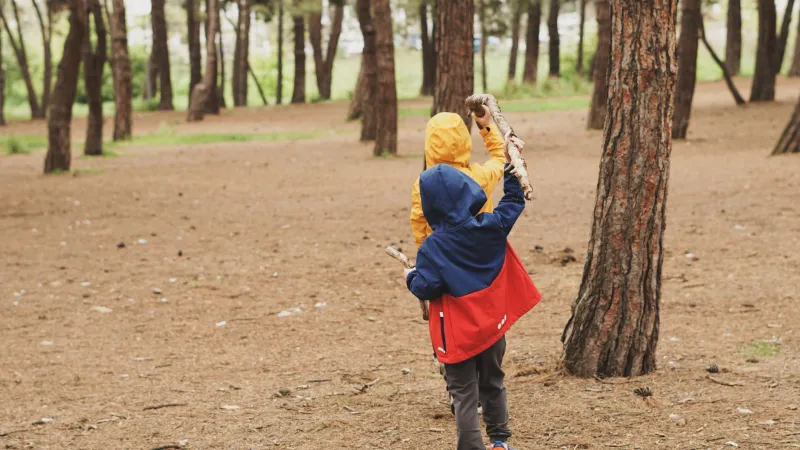
One of the most concrete expressions of this philosophy is the Norwegian concept of friluftsliv — literally "open-air living" — which gets introduced to kids practically from birth. Norwegian infants nap outside in their prams in near-freezing temperatures. Preschoolers in Sweden and Denmark spend hours each day in unstructured outdoor play, regardless of weather. The phrase you'll hear across Scandinavia is some version of: there's no bad weather, only bad clothing.
This isn't just about getting fresh air. It's a foundational belief that children belong in the natural world, that their bodies and minds develop better when they're allowed to move freely through it, and that a scraped knee or a muddy boot is not a parenting failure — it's evidence that something went right.
American outdoor play, by comparison, has been quietly shrinking for decades. Studies from the American Academy of Pediatrics have documented the decline in unstructured outdoor time for U.S. kids, replaced by supervised activities, screen time, and safety-first environments where the risk of minor injury often outweighs the perceived benefit of free exploration. Nordic educators and child development researchers would find that trade-off baffling.
School Without the Pressure Cooker
The parenting philosophy extends into education, too. Finland — often held up as the gold standard of global education — doesn't start formal schooling until age seven. Before that, learning is almost entirely play-based. There are no standardized tests for young children, no reading drills at age four, no homework in the early years.
And yet Finnish students consistently rank among the highest in the world for literacy and critical thinking by their teenage years.
American parents are often told that early academic pressure is necessary to keep kids competitive. The Finnish experience suggests the opposite might be true: that children who are given time to develop curiosity, social skills, and self-regulation through play arrive at formal learning more ready, not less.
The pressure to perform early — which many American parents feel acutely and pass directly onto their kids — doesn't appear to produce better outcomes. It does appear to produce more anxious ones.
Trust as a Parenting Tool
Perhaps the most radical element of the Nordic approach is the role of trust. Scandinavian parents extend a level of trust to their children that can seem almost reckless from the outside.
Kids walk to school alone. They ride public transit by themselves. They're allowed to disagree with adults, express frustration openly, and work through social conflict without a parent swooping in to mediate. The assumption baked into all of this is that children are fundamentally capable — that given the chance, they will figure things out.
This trust isn't blind. It's calibrated to the child's actual age and development, and it expands gradually as the child demonstrates readiness. But the default setting is autonomy, not supervision.
Compare that to the default setting in many American households, where the instinct is to manage first and step back only when the child proves they can handle it. The Nordic model essentially flips that dynamic: freedom is the starting point, and it's only pulled back when there's a genuine reason to do so.
What Guilt Has to Do With It
Here's where it gets personal. American parenting culture is, to a significant degree, a guilt culture. Parents are bombarded with messages about everything they might be doing wrong — not reading enough to the baby, not buying the right toys, not being present enough, not setting enough limits. The anxiety is relentless, and it's largely self-generated.
Scandinavian parenting operates with notably less of this guilt. Part of that is structural — Nordic countries have robust parental leave policies, affordable childcare, and social safety nets that reduce the financial and logistical stress that American parents carry. When you're not choosing between your job and your kid's daycare, the mental load lightens considerably.
But it's also cultural. The Nordic conception of a "good parent" isn't someone who does everything for their child. It's someone who raises a child who eventually doesn't need them to. Independence isn't the goal you work toward after childhood — it's the thing you're building from day one.
Can Any of This Actually Travel?
American parents who encounter these ideas often feel two things simultaneously: genuine interest, and immediate skepticism about whether any of it applies to their lives. And fair enough — you can't just drop a Copenhagen parenting philosophy into a suburb of Atlanta and expect it to translate without friction.
The legal and social context is different. American neighborhoods vary wildly in terms of walkability and safety. The cultural expectation that children will be supervised is so strong that a parent who lets their nine-year-old walk to the park alone might face judgment — or worse, a call to child protective services.
But there are pieces worth borrowing. The commitment to unstructured outdoor time doesn't require a Scandinavian forest. Trusting a child to navigate a minor social conflict without intervention is possible in any backyard. Resisting the urge to fill every free hour with structured activity is a choice that's available regardless of zip code.
The bigger shift isn't logistical — it's philosophical. It's asking yourself whether your involvement in your child's life is actually serving them, or whether some of it is serving your own anxiety about being a good parent.
Scandinavian parents, by and large, seem to have made peace with that question. Their kids, by most measures, are doing just fine.
Maybe there's something to letting them fall after all.